
For years, traditional personal finance apps slapped us with a heavy mental tax. They demanded hours of manual expense logging, tedious CSV downloads, and endless guilt trips over a grocery bill. They showed us where our money went, but did absolutely nothing to change where it was going.
Welcome to 2026, where the paradigm has shifted from passive financial tracking to autonomous finance and execution. Today’s best AI personal finance tools don’t just sit back and watch you spend; they act as a proactive, digital CFO. By utilizing advanced financial LLMs, predictive spending analysis, and open banking APIs, these platforms automate your savings, negotiate bills, and optimize investments in real time.

If you are tired of the spreadsheet grind and want a self-driving wallet that builds wealth in the background, here is your definitive, human-tested guide to the top AI financial tools ruling 2026.
Why AI is No Longer Optional for Your Wallet
Relying on a backward-looking budget in today’s fast-moving economy is like trying to drive down a highway while only looking in the rearview mirror. Financial markets shift instantly, and inflation impacts different household categories erratically.
Traditional apps tell you what happened last Tuesday. The new wave of AI financial tools uses predictive spending analysis to look forward. For example, an AI tool can analyze your Google Calendar, spot an upcoming weekend trip, cross-reference it with your historical dining habits, and warn you on a Wednesday morning:
“Based on your upcoming schedule, you are on track to overspend your discretionary budget by $65 this weekend. Adjusting your automated Friday saving transfer now to keep your emergency fund on track.”
By shifting from manual tracking to automated execution, these tools eliminate human procrastination, remove emotional panic from investing, and actively protect your cash from inflation.
The 10 Best AI Personal Finance Tools of 2026: Detailed Reviews
1. WallyGPT 4.0: Best for Conversational Finance
Wally was one of the earliest platforms to integrate large language models into daily banking, but version 4.0 strips away complex dashboards entirely. It replaces confusing graphs with a hyper-intelligent, context-aware chat interface.
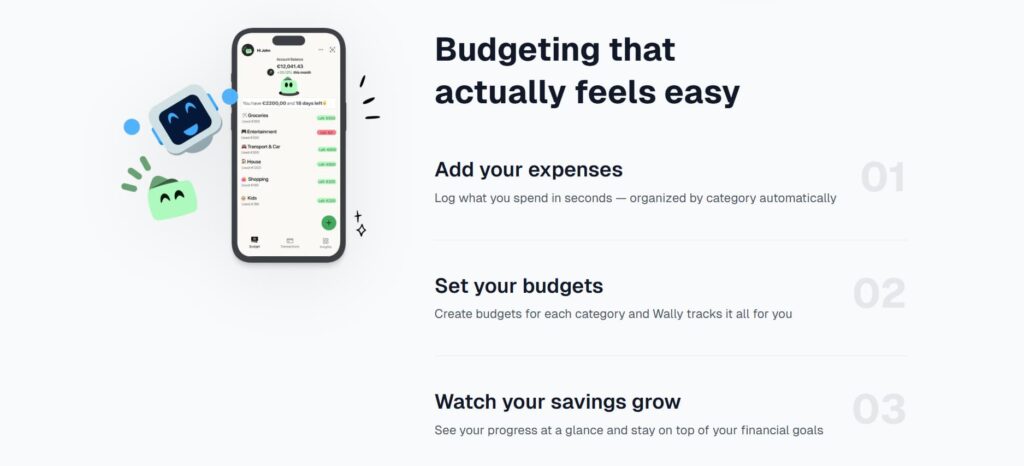
Core Features: Natural language financial querying, real-time cross-account scanning, instant macroeconomics impact reports.
Who It’s For: Professionals who want instant, conversational answers to complex financial questions without digging through multi-tab menus.
My Personal Insight: The true “AI Edge” here is intent recognition. You can type: “Can I afford a $1,200 flight to Tokyo next month without delaying my home down-payment goal?” The app instantly runs a Monte Carlo simulation against your income, fixed liabilities, and current investment yields to give you a definitive: “Yes, if you reduce luxury spending by 12% over the next 21 days.“
| Official Website; | Click Here |
2. Rocket Money AI: Best for Automated Bill Negotiation
Rocket Money has evolved from a simple subscription tracker into an aggressive financial advocate. It takes the awkward, time-consuming chore of fighting corporate price creep and automates it completely.
Core Features: Autonomous bill negotiation webhooks, predictive subscription auditing, local utility cost benchmarking.
Who It’s For: Anyone dealing with subscription fatigue who wants an algorithmic assistant to fight back against hidden fees.
The AI Edge: Instead of just sending you a notification that your internet bill increased, Rocket Money’s AI agent deploys automated negotiation bots. These bots interact directly with service provider portals, match localized promotional rates, and lower your bill without you ever picking up the phone.
| Official Website; | Click Here |
3. Copilot IQ: Best for High-Net-Worth Tracking
Copilot has long been celebrated for its stunning user interface, but the introduction of its “IQ” machine learning layer elevates it to a true family-office alternative for tracking complex, diverse asset classes.

Core Features: Multi-brokerage algorithmic syncing, smart tax-loss harvesting alerts, real-time net worth projections.
Who It’s For: High earners, tech professionals, and freelancers managing multiple income streams, real estate, and crypto portfolios.
The AI Edge: Copilot IQ analyzes your wealth holistically. If a major client invoice clears into your checking account, it doesn’t let the cash sit idle. It reviews your risk profile across external brokerages and builds an instant deployment roadmap, showing you exactly how to route the funds to minimize tax drag,
| Official Website; | Click Here |
4. Cleo: Best for Behavioral Spending Changes
If standard financial advice feels dry or out of touch, Cleo is the antidote. It combines advanced behavioral psychology with generative AI to fundamentally alter how you interact with daily money decisions.
Core Features: Hyper-personalized “Roast” or “Hype” modes, predictive overdraft prevention, gamified savings challenges.
Who It’s For: Gen Z and young professionals looking to break the paycheck-to-paycheck cycle through habit formation.
The AI Edge: Cleo uses emotional intelligence to drive compliance. Toggle on “Roast Mode,” and the AI will ruthlessly call you out using internet culture humor the moment you open a food delivery app for the third time in a week. It turns budget compliance into an addictive game.
| Official Website; | Click Here |
5. Monarch Money: Best for Couple and Households
Managing joint finances is historically a friction point for relationships. Monarch Money uses AI to act as a neutral, data-driven digital family accountant that keeps everyone on the same page.
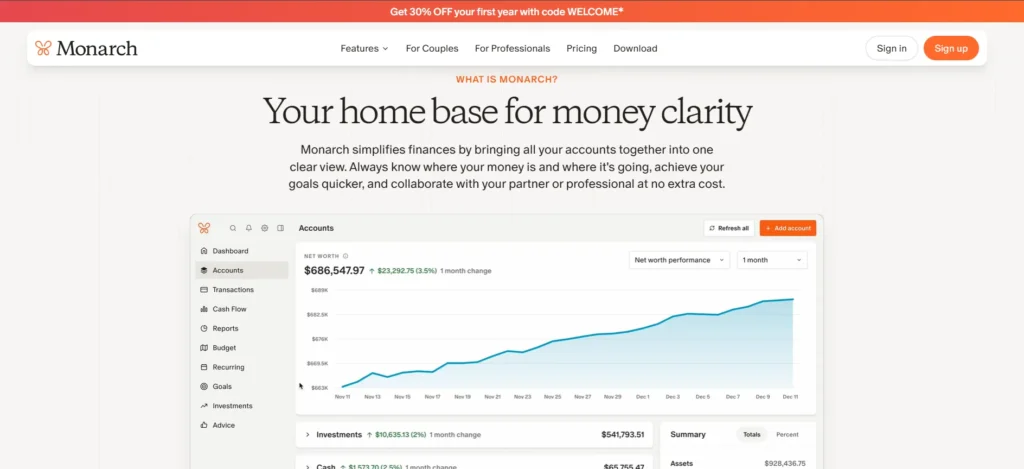
Core Features: Shared multi-user AI workspaces, collaborative long-term goal mapping, automated semantic transaction rules.
Who It’s For: Partners, married couple, and co-living arrangements trying to merge financial ecosystems seamlessly.
The AI Edge: Its deep learning engine automatically scans splits bills and recurring household expenses, assigning them to the correct shared pool without manual tag management. If a joint vacation fund is falling behind pace, the AI delivers a stress-free brief suggesting three under-utilized subscriptions the household can safely pause.
| Official Website; | Click Here |
6. Magnifi: Best for Conversational Investing
Magnifi transaction the power of AI from daily budgeting into institutional-grade investment intelligence, giving retail investors a massive edge.
Core Features: Natural language investment discovery, algorithmic portfolio health scoring, automated risk-exposure analysis.
Who It’s For: Everyday investors who want to move beyond basic index funds but want to avoid the high fees of traditional wealth managers.
The AI Edge: It operates like a personalized Bloomberg Terminal. You can query: “How exposed is my portfolio to global supply chain issues, and what clean energy ETFs can I buy to hedge against it?” The tool analyzes your current brokerage holding and generates instant, actionable buy/sell roadmaps.
| Official Website; | Click Here |
7. Tiller (with GPT-40 Integration): Best for Spreadsheet Purists
For those who refuse to abandon the absolute customization and data privacy of Microsoft Excel or Google Sheets, Tiller provides the ultimate automated bridge.
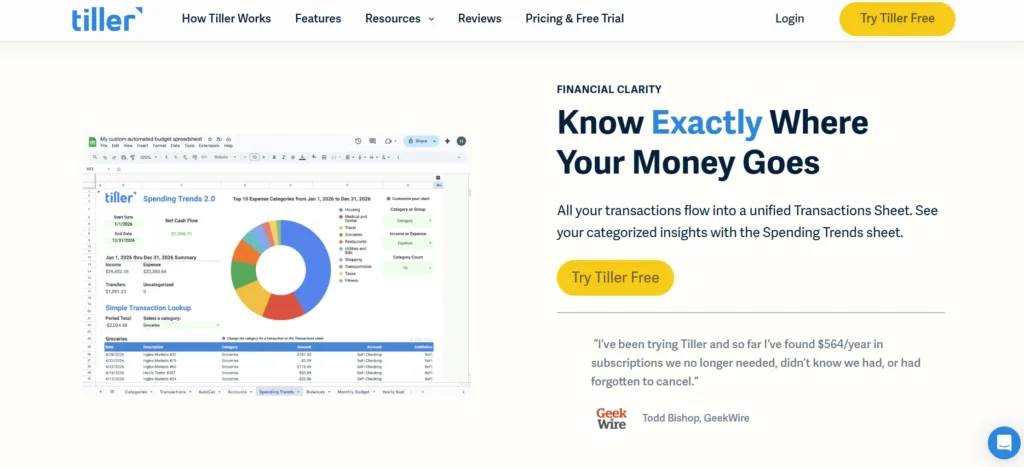
Core Features: Direct bank-to-sheet automated data pipelines, customizable open-source templates, semantic LLM script generation.
Who It’s For: Data analysts, financial purists, and DIY builders who want absolute control over their underlying data.
The AI Edge: With native GPT-40 sidebars built into your sheets, you no longer need to write complex VLOOKUP formulas. You can prompt your spreadsheet in plain English: “Analyze the last 90 days of unstructured transaction lines, flag any duplicate SaaS charges, and build a forecast chart for next quarter’s tax liabilities.”
| Official Website; | Click Here |
8. Empower: Best for Long-Term Retirement Forecasting
Empower combines its deep history in wealth management with an algorithmic forecasting engine designed to stress-test your wealth across decades.
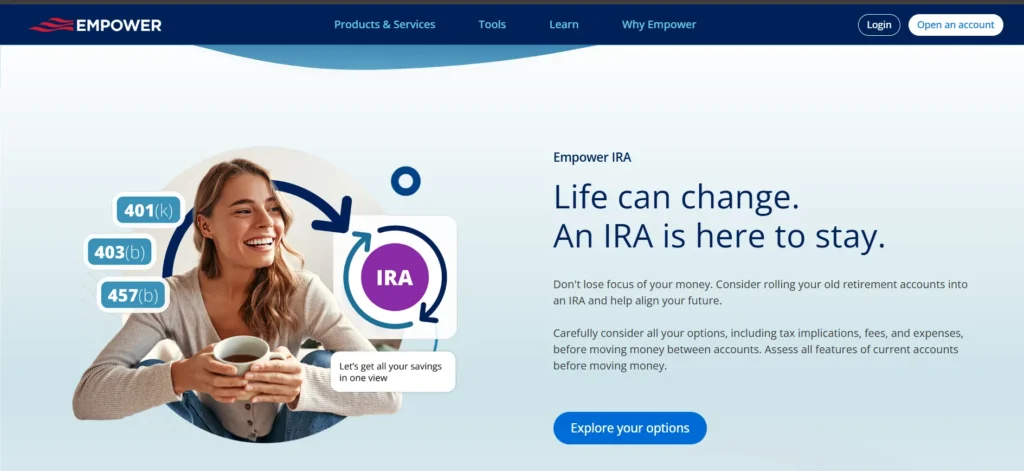
Core Features: Automated investment free-analyzers, estate planning tools, real-time Monte Carlo retirement simulators.
Who It’s For: Mid-career professionals and long-term wealth builders focused on retirement preparation and legacy planning.
The AI Edge: Empower’s backend constantly runs thousands of background simulations against shifting tax brackets and macroeconomy indicators. It answers major life questions like: “Can I safely transition to part-time consulting at age 52 if inflation averages 4% over the next decade?” with extreme mathematical accuracy.
| Official Website; | Click Here |
9. PocketGuard: Best for Debt Paydown & Cash Flow Clarity
PocketGuard focuses strictly on the metrics that prevent overspending, making it the perfect tool for getting out of debt aggressively.
Core Features: Real-time “In My Pocket” daily spending algorithm, automated debt snowball/avalanche modeling, bill tracking.
Who It’s For: Individuals looking to destroy consumer debt or gain absolute clarity on their daily liquid spending limits.
The AI Edge: Instead of simply subtracting static bills from your income, PocketGuard’s predictive algorithm tracks rolling 30-day bill cycles and real-time variable spikes. If you make an unexpected purchase in the morning, your “In My Pocket” daily limit updates instantly to ensure your debt paydown goals are never compromised.
| Official Website; | Click Here |
10. FinChat.io: Best for Fundamental Stock & Crypto Research
FinChat.io completely bypasses general web searches to deliver verified, institutional-grade equity and crypto data directly to self-directed investors.
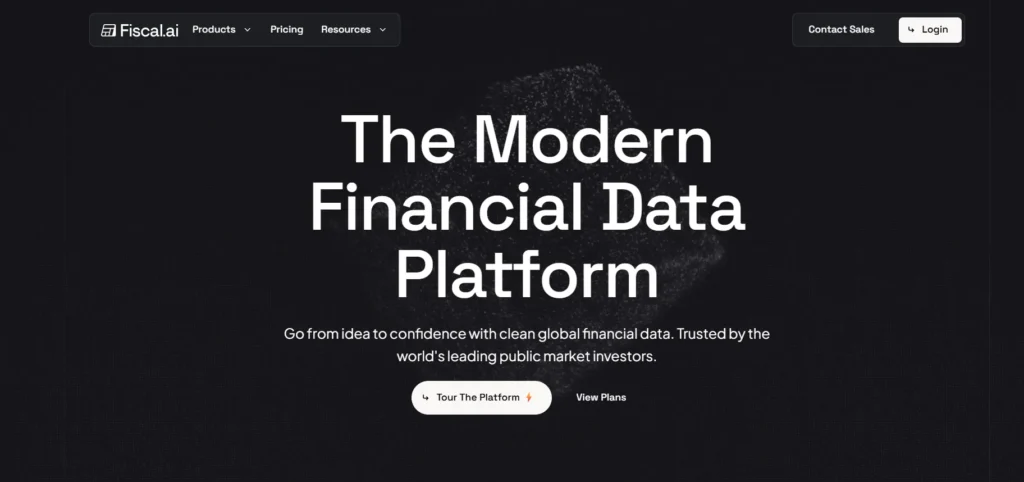
Core Features: Direct indexing of global SEC filing, earning call transcript analysis, on-chain crypto asset tracking.
Who It’s For: Active stock traders, market research enthusiasts, and crypto investors who demand hard numbers over social media sentiment.
The AI Edge: FinChat is explicitly trained on verified corporate financial structures. You can ask: ”Compare Tesla’s Q1 automotive margins against BYD, and highlight what management said about battery constraints in the earning transcript.” The AI will instantly return structured financial tables and direct text citations.
Comparison Matrix: Finding Your Perfect AI Financial Match
| AI Tool | Standout Feature | Best For | Platform | Pricing Structure |
| WallyGPT 4.0 | Conversational UI | Busy Professionals | iOS, Android | Free Tier/ $8/mo premium |
| Rocket Money AI | Autonomous Bill Bots | Lowering Fixed Bills | iOS, Android, Web | $5 – $15/mo Sliding Scale |
| Copilot IQ | Investment Tracking | High Earners | iOS, Mac, Web | $12/mo or $110/yr |
| Cleo | Behavioral Hype/Roast | Habit Modifications | iOS, Android | Free Tier / $5.99/mo plus |
| Monarch Money | Household Syncing | Couples & Families | iOS, Android, Web | $14.99/mo or $99.99/mo |
| Magnifi | Portfolio Chatbot | Active Investors | iOS, Android, Web | $14/mo |
| Tiller (GPT-40) | Bank-to-sheet pipelines | Spreadsheet Nerds | Sheets, Excel | $79/yr |
| Empower | Retirement Simulators | Long-Term Planners | iOS, Android, Web | Free Dashboard Tools |
| PocketGuard | “In My Pocket” Metric | Debt Paydown | iOS, Android | Free Tier / $7.99/mo Plus |
| FinChat.io | SEC Filing Analytics | Equity Research | Web, Mobile | Free Tier / $29/mo Pro |
The Security and Privacy Landscape of AI Banking
Is it safe to give an AI access to your financial data? This is the most crucial question you must ask before implementing an autonomous finance strategy.
In 2026., the best AI personal finance tools protect your data by strictly separating identity from credentials. These apps never store your actual banking password. Instead, they leverage secure, read-only tokenization systems via established open-banking networks like Plaid. Data transmission is protected using quantum-resistant AES-256 end-to-end encryption standards.
3 Non-Negotiable Security Steps for Users:
- Audit Connected APIs Regularly: Every six months, log into your primary bank’s security dashboard (e.g., Chase, Bank of America) and manually revoke access to any financial applications you are no longer actively using.
- Enforce Hardware-Based MFA: Always protect your financial app profiles with app-based multi-factor authentication (like Google Authenticator). Avoid SMS-based 2FA, which remains highly vulnerable to SIM-swapping exploits.
- Opt Out of Model Training: Navigate to the privacy setting menu of your chosen app and ensure your personal transaction histories are opted out of global LLM training data pools.
Pro-Tips: How to Train Your AI to Save $500+ Monthly
Toggle Operational Saving Profiles: Most premium platform allow you to switch between Aggressive and Passive algorithmic saving. If your primary checking account has excess cash flow, set it to “Aggressive.” The tool will identify micro-pockets of idle money and automatically route them to high-yield saving vehicles multiple times a week.
Deploy Real-Time Webhook Digests: Do not rely on opening the apps to check progress. Connect your financial tools automated alerts directly to a private Discord channel or Telegram bot to receive frictionless, daily summaries of anomalous spending behavior or net worth updates.
Pros and Cons of Autonomous Finance
Pros
- Speed and Precision: Algorithms spot fee anomalies, tracking mistakes, and market trends days before a human would notice.
- Emotional Execution: Eliminates impulse purchases and blocks panic-selling during sudden market pullbacks.
- Massive Time Savings: Hands you back hours of administrative time by completely taking over categorization and bill auditing.
Cons
- Subscription Creep: Many premium features a paid subscription. You must ensure the app actively saves you more than its operational cost.
- The Risk of Financial Disconnection: Total automation can cause you to stop looking at your money entirely. Healthy financial habits still require high-level awareness.
Frequently Asked Questions (FAQ)
Q1. Is AI budgeting safe to use?
Yes. Reputable platforms use only financial APIs like Plaid, meaning they can analyze your spending trends but have absolutely no authority or technical capability to move or withdraw your money without explicit open banking authentication tokens.
Q2. Can an AI tool actually lower my cable or internet bill?
Yes. Tools like Rocket Money deploy specialized conversational webhooks that chat directly with provider retention portals. They systematically match active regional promotions and eliminate hidden infrastructure fees automatically.
Q3. Do I still need a traditional human financial advisor?
For complex tax mitigation strategies, estate setups, corporate restructuring, or deep emotional coaching during major life changes, human professionals are still highly recommended. For routine cash flow automation, daily budgeting, and portfolio tracking, AI tools offer a faster, cheaper, and incredibly accurate alternative.